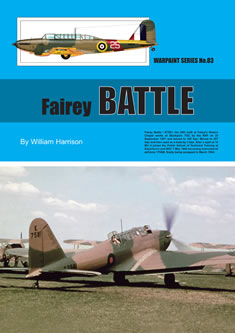
Fairey Battle
Product code WS-83
Fairey
Series Warpaint Series No 83
Publisher/Brand Hall Park
Author William Harrison
Format a4
No. Pages 60
Version Soft cover
Language English
Category Aviationbooks
Subcategory WW2 UK » WW2 UK Aircraft
Availability only 1 remaining
This product was added to our database on Friday 5 August 2011.
Your reliable Aviation Book Source since 1989
Also in this series:
| Product | Publisher/Brand | Series/scale | Price € | ||
|---|---|---|---|---|---|
 | Avro Lancaster | Hall Park | Warpaint Series No 89 | € 18.30 | |
 | Bristol Beaufighter | Hall Park | Warpaint Series No 1 | € 12.80 | |
 | Gloster Javelin | Hall Park | Warpaint Series No 17 | € 12.80 | |
 | Heinkel He177 Greif | Hall Park | Warpaint Series No 33 | € 13.72 | |
 | Lockheed P2V Neptune | Hall Park | Warpaint Series No 51 | € 16.47 | |
 | North American B25 Mitchell | Hall Park | Warpaint Series No 73 | € 15.55 | |
 | North American B45 Tornado | Hall Park | Warpaint Series No 118 | € 16.47 | |
 | Panavia Tornado ADV | Hall Park | Warpaint Series No 113 | € 17.39 | |
 | Sopwith Pup | Hall Park | Warpaint Series No 105 | € 14.63 | |
 | Supermarine Scimitar | Hall Park | Warpaint Series No 85 | € 15.55 |
The Fairey Battle was not a failure!
British Prime Minister, Winston Churchill, said in the House of Commons on 20 August, 1940 - ....'on no part of the RAF does the weight of war fall more heavily than on the daylight bomber'.... . A reflection of what happened in the Low Countries during May/June 1940. The Battle was not mis-used during this debacle. The Air Staff, before the war, had planned against such an attack by Germany through the Low Countries, the Blitzkrieg was just outside their experience and the light bombers were thrust in at low level against a rapidly moving and heavily armed enemy.
It is also unfair for aviation journalists to compare the performance of a Battle against the new emerging single-engined fighters. It was a large but graceful design, and by contemporary standards was advanced for its day. Originally conceived within the limits of the Geneva Disarmament Conference the Battle would, by the time the second world war opened, have over 1000 aircraft in RAF service providing vital aircrew experience of a modern monoplane with a retractable undercarriage, variable-pitch propellers and hydraulic systems.
After withdrawal from front line squadrons the Battle airframe was adapted to provide experimental test bed work and give trainee aircrews extensive flying training in the UK, Australia, Canada, South Africa and Southern Rhodesia. More than half of all Battles built were later used in the training role - many continuing in use until 1945 or after!

